

What Is GLM 5.2? (And Why Is Everyone Talking About It?)
If you follow artificial intelligence news in the UK or USA, you may have noticed GLM 5.2 trending across developer communities this week. Released on June 13, 2026, by Chinese AI company Z.ai (Zhipu AI), GLM 5.2 is an open-source AI model that has taken the tech world by surprise — outperforming OpenAI’s GPT-5.5 on keycoding benchmarks — for another powerful AI coding tool, read our Grok 4.5 Coding Review 2026 benchmarks while costing roughly six times less to run.
But what exactly is GLM 5.2? Who built it? And should developers in the UK and USA be paying attention?
This complete GLM 5.2 review covers everything — from its core features and benchmark results to pricing, access options, and how it stacks up against the competition.
Who Built GLM 5.2? — The Story Behind Z.ai
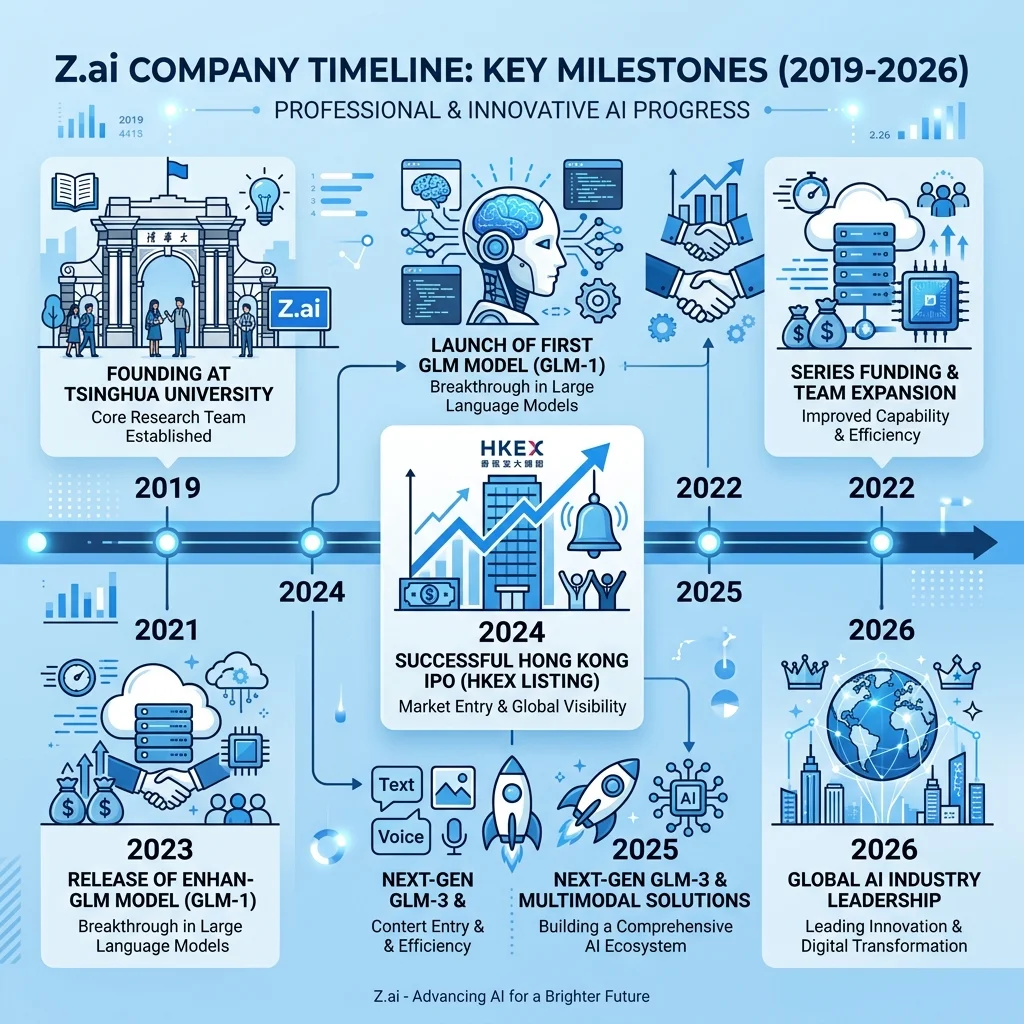
Z.ai, also known internationally as Zhipu AI, is a Beijing-based AI company that was spun out of Tsinghua University in 2019. The company listed on the Hong Kong Stock Exchange in January 2026, raising approximately USD 558 million at a market valuation of around USD 52.83 billion.
GLM 5.2 is the third major release in Z.ai’s GLM-5 family, following GLM-5 (February 2026), GLM-5-Turbo (March 2026), and GLM-5.1 (April 2026). The company has shipped four flagship-level coding models in just four months — a pace that has stunned even seasoned AI observers.
The timing of its launch was also deliberate. It arrived just 48 hours after US export control directives forced Anthropic to shut down its top Fable 5 and Mythos 5 models for foreign users. Z.ai’s founder Jie Tang publicly addressed this, stating the path to AGI should not be surrounded by high walls — a clear statement of intent in the ongoing US-China AI race.
7 Key Features of GLM 5.2 You Need to Know
1. Massive 1 Million Token Context Window
The single biggest upgrade in GLM 5.2 is its 1 million token context window — a five-times increase over its predecessor GLM-5.1, which supported only 200,000 tokens.
In real-world terms, this means you can feed it an entire software codebase, a full book, or hours of meeting transcripts — and it will reason across all of it in a single session without losing context.
For UK and USA developers working on large-scale enterprise software projects, this capability is genuinely transformative.
2. Beats GPT-5.5 on Coding Benchmarks
GLM 5.2 has posted impressive results across multiple independent coding benchmarks:
| Benchmark | GLM 5.2 | GPT-5.5 | Claude Opus 4.8 |
|---|---|---|---|
| SWE-bench Pro | 62.1 | 58.6 | ~63 |
| FrontierSWE | 74.4% | 72.6% | 75.1% |
| MCP-Atlas (Tool Use) | 77.0 | 75.3 | — |
| Terminal-Bench | 81.0% | — | — |
| Humanity’s Last Exam | 54.7 | 52.2 | — |
It outperforms GPT-5.5 across the board on coding tasks, coming within 1% of Claude Opus 4.8 on FrontierSWE — and costs a fraction of either.
3. Open Source Under MIT License — Completely Free to Use
One of its most powerful advantages is the MIT open-source license This means:
- Download and self-host it for free
- Fine-tune it for your specific use case
- Use it commercially without restrictions
- Run it locally — no data sent to third-party servers
For UK businesses concerned about GDPR compliance and data privacy, the ability to self-host a frontier-level AI model locally is a significant advantage.
4. Dual Thinking Modes — High and Max
It introduces a streamlined dual thinking-effort system:
- High Mode — For standard complex coding tasks
- Max Mode — For the most demanding multi-step engineering workflows
Z.ai removed the previous Auto and Low settings, signalling that it is built for serious, sustained work — not quick lookups or simple queries.
5. Trained on Huawei Hardware — No NVIDIA Chips
A remarkable technical fact: GLM 5.2 was trained entirely on Huawei Ascend 910B chips using the MindSpore framework — without a single NVIDIA GPU.
This matters for two reasons. First, it demonstrates that frontier-level AI can be developed outside the US chip supply chain. Second, for enterprises concerned about geopolitical supply-chain risks, it represents a model that was built and can be run entirely independent of US hardware dependencies.
6. IndexShare — 2.9x More Efficient at Long Context
It introduces a new architectural optimisation called IndexShare, which reuses the same indexer across every four sparse attention layers.
The result: per-token compute operations are reduced by 2.9 times at the maximum 1 million token context length. This makes running the model dramatically cheaper and faster for long-context tasks — a key advantage for enterprise users processing large documents or codebases.
7. Costs 6x Less Than GPT-5.5
Perhaps the most compelling reason to consider GLM 5.2 is its price:
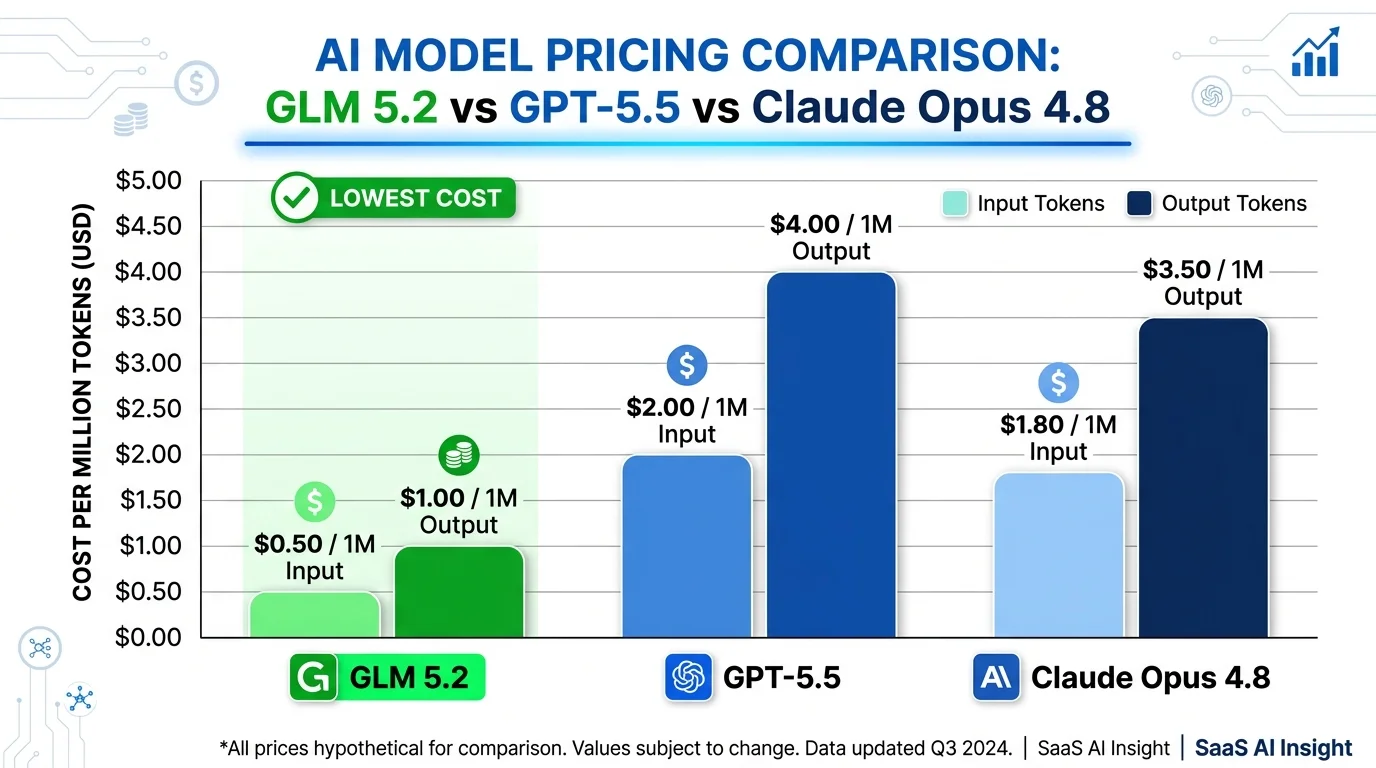
| Model | Input (per 1M tokens) | Output (per 1M tokens) | Total |
|---|---|---|---|
| GLM 5.2 | $1.40 | $4.40 | $5.80 |
| GPT-5.5 | $5.00 | $30.00 | $35.00 |
| Claude Opus 4.8 | $5.00 | $25.00 | $30.00 |
It delivers comparable — and in some cases superior — coding performance at roughly one-sixth the cost of GPT-5.5 and one-fifth the cost of Claude Opus 4.8.
How to Access GLM 5.2 — Step by Step
Option 1: GLM Coding Plan (Subscription)
The simplest way to get started:
- Go to z.ai
- Sign up for a GLM Coding Plan — starting at around $10/month (Lite tier)
- Select GLM 5.2 from your model options
- Integrate with your preferred coding IDE
Available tiers:
- Lite ~$10/month (~400 prompts/week)
- Pro ~$30/month (~2,000 prompts/week)
- Max Higher volume (~8,000 prompts/week)
- Team Seat-based enterprise pricing
Option 2: Standalone API
Standalone API access with token-based pricing ($1.40 input / $4.40 output per 1M tokens) became available in mid-June 2026. Compatible with eight major coding agents including Claude Code, Cline, Roo Code, Goose, Kilo Code, and OpenCode via an OpenAI-compatible endpoint.
Option 3: Self-Host (Open Weights)
The MIT-licensed open weights are available on Hugging Face under the zai-org account. This option is free — you only pay for your own compute and electricity costs.
GLM 5.2 vs GPT-5.5 vs Claude Opus 4.8 — Full Comparison
| Feature | GLM 5.2 | GPT-5.5 | Claude Opus 4.8 |
|---|---|---|---|
| Context Window | 1M tokens | 128K tokens | 1M tokens |
| Open Source | ✅ MIT License | ❌ Closed | ❌ Closed |
| SWE-bench Pro | 62.1 | 58.6 | ~63 |
| FrontierSWE | 74.4% | 72.6% | 75.1% |
| API Cost (combined) | $5.80/1M | $35.00/1M | $30.00/1M |
| Self-hostable | ✅ Yes | ❌ No | ❌ No |
| Trained without NVIDIA | ✅ Yes | ❌ No | ❌ No |
| Available globally | ✅ Yes | ⚠️ Restricted | ⚠️ Restricted |
Who Should Use GLM 5.2?
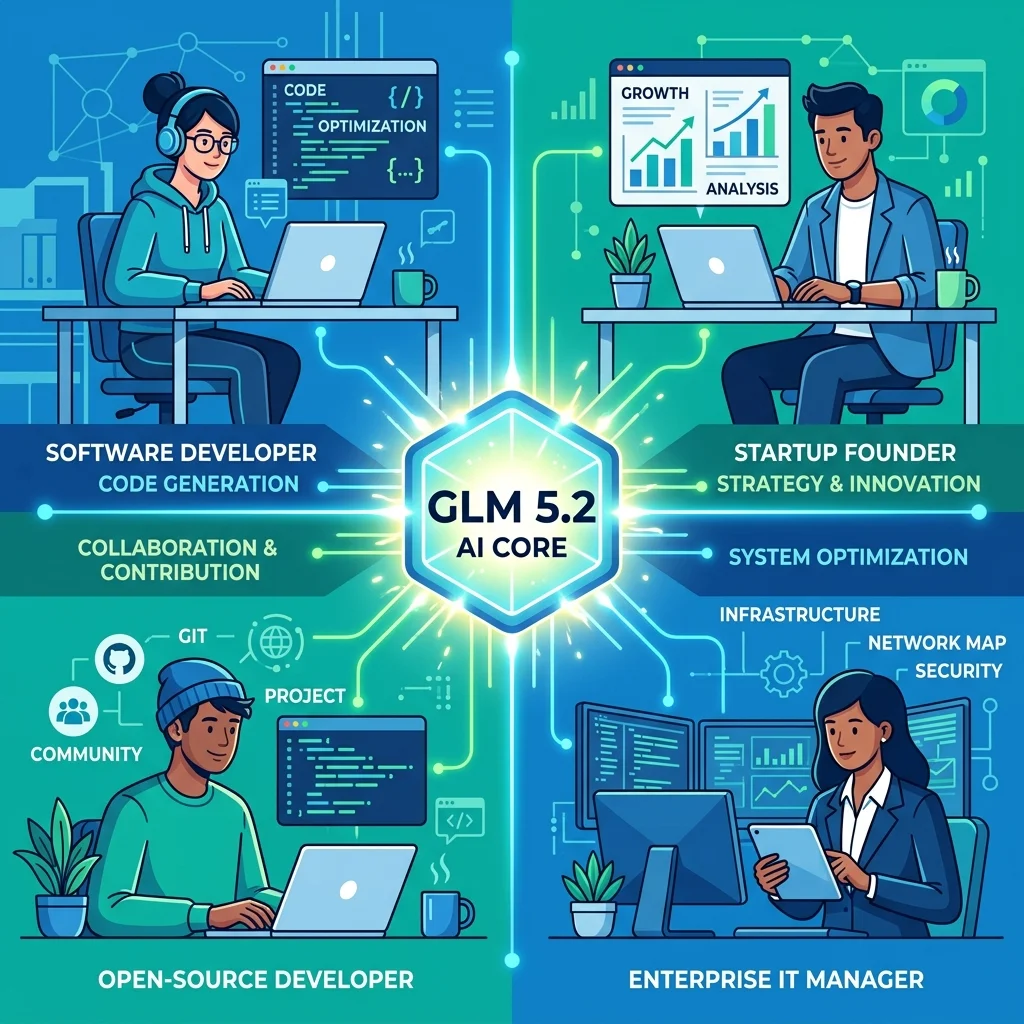
✅ Software Developers & Engineers If you work on large codebases and need an AI that can hold an entire repository in context — it is built for exactly this workflow.
✅ Startups & Bootstrapped Founders At one-sixth the price of GPT-5.5, it makes frontier-level AI coding assistance genuinely affordable — and if you want to save money fast on a low income UK, our guide has more practical tips for small teams and solo developers.
✅ Enterprise Teams in UK & Europe The ability to self-host under an MIT license means full data sovereignty — a critical requirement for GDPR compliance and enterprise data security policies.
✅ Developers Outside the USA Following US export control restrictions on top Anthropic models, this model offers a globally accessible, unrestricted alternative with no geographic fencing.
✅ Open-Source Advocates GLM 5.2 is one of the few frontier-level models available under a completely permissive MIT license — you can download, modify, and deploy it freely.
Frequently Asked Questions About GLM 5.2
What is GLM 5.2?
GLM 5.2 is an open-source large language model released by Z.ai (Zhipu AI) on June 13, 2026. It features a 1 million token context window, dual thinking modes, and an MIT license — making it one of the most capable and accessible AI models available today.
Is GLM 5.2 free?
The open weights are free to download and self-host under an MIT license. Subscription-based access starts at around $10/month via the GLM Coding Plan. Standalone API access is available at $1.40 per million input tokens.
Is GLM 5.2 better than ChatGPT?
On key coding benchmarks, GLM 5.2 outperforms GPT-5.5 — scoring 62.1 vs 58.6 on SWE-bench Pro and 74.4% vs 72.6% on FrontierSWE. It also costs approximately six times less to run via API.
Is GLM 5.2 available in the UK?
Yes. It is available globally with no geographic restrictions — a key advantage over some US-based models that have faced access limitations for non-US users.
Can I use GLM 5.2 for commercial projects?
Yes. The MIT license permits commercial use, modification, and redistribution without restrictions.
How does GLM 5.2 handle data privacy?
Self-hosted deployments keep all data on your own infrastructure. For UK businesses, this makes GDPR compliance straightforward. Note that using Z.ai’s cloud API means data passes through Z.ai’s servers, which are subject to Chinese data law — something enterprise users should factor into their decision.
What coding tools support GLM 5.2?
It is compatible with Claude Code, Cline, Roo Code, Goose, Kilo Code, OpenCode, Crush, and OpenClaw via an OpenAI-compatible API endpoint.
Final Verdict: Is GLM 5.2 Worth It in 2026?
After this complete GLM 5.2 review, the conclusion is clear — for developers and engineering teams in the UK and USA, GLM 5.2 deserves serious consideration.
Its combination of a true 1 million token context window, benchmark-leading coding performance, MIT open-source licensing, and dramatically lower cost than US proprietary alternatives makes it one of the most compelling AI releases of 2026.
The only caveats worth noting are the absence of official benchmarks at launch (since resolved), and the fact that cloud API usage is subject to Chinese data jurisdiction — a factor enterprise teams should assess carefully.
For self-hosted deployments, open-source teams, and cost-conscious developers, it is an easy recommendation.