


What Are Gen Z Money Habits in the UK in 2026?
Gen Z Money Habits UK 2026 are more surprising than most people expect. When people talk about this topic, most assume the generation is struggling financially — spending everything on takeaways, coffee, and social media subscriptions.. — spending everything on takeaways, coffee, and social media subscriptions. But the data tells a very different story.
Gen Z — broadly defined as those born between 1997 and 2012 and now aged 14 to 27 — is quietly rewriting the rules of personal finance in the UK. Despite facing some of the toughest economic conditions of any modern generation, including sky-high housing costs, student debt, and lingering inflation, a growing number of young Brits are building surprisingly strong money habits.
In this complete guide, we explore seven of the most surprising Gen Z money habits shaping personal finance in the UK in 2026 — backed by real data and what it means for young people across Britain and the USA.
Who Is Gen Z? — The Numbers Behind the Generation
Before diving into the habits, here is a quick snapshot of where Gen Z stands financially in the UK right now:
| Metric | Gen Z UK 2026 |
|---|---|
| Average savings | £4,002 |
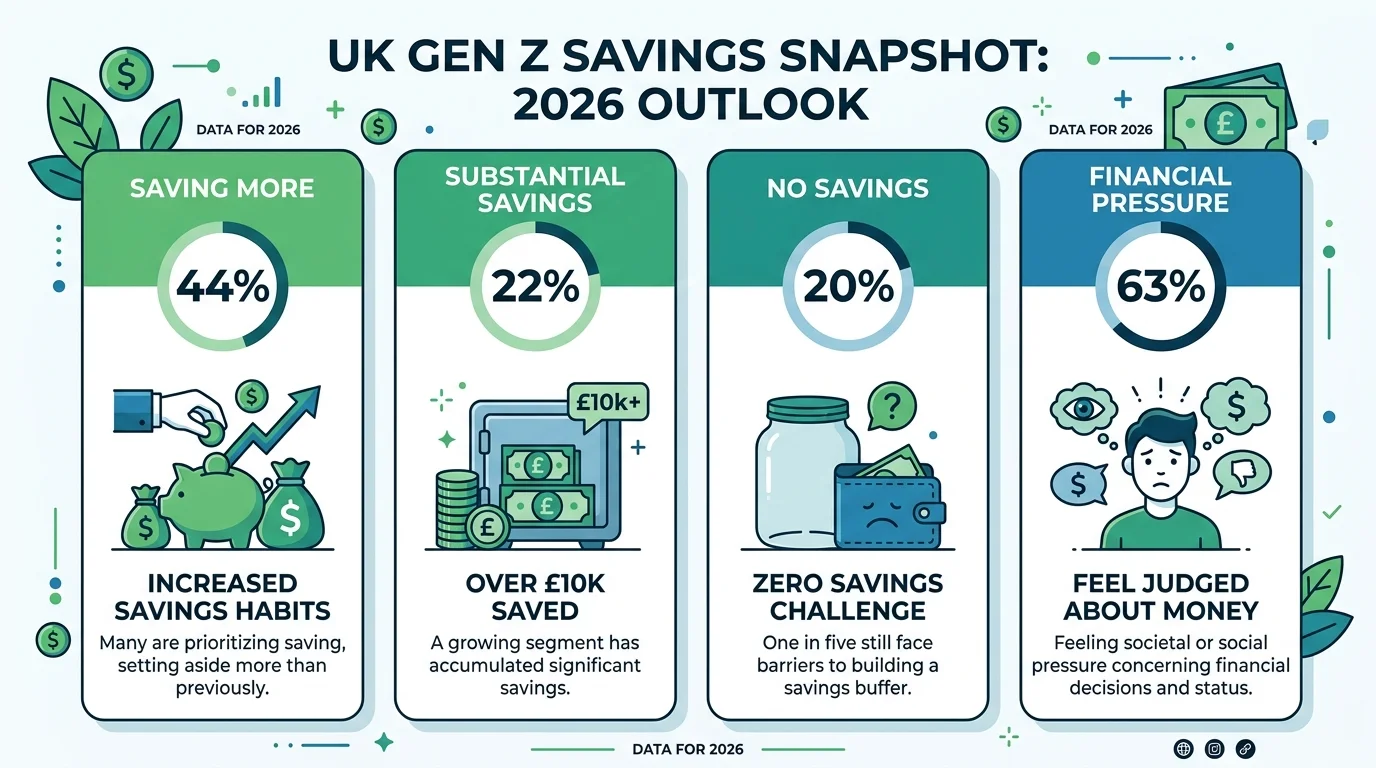
| Already have £10,000+ saved | 22% |
| Saving more than usual in Q1 2026 | 44% |
| Have no savings at all | 20% |
| Turn to social media for financial advice | 22% |
| Feel judged about how they manage money | 63% |
| Feel income does not cover living costs | 25% |
The picture is complex. Gen Z is simultaneously the most savings-motivated and the most financially pressured generation in the UK today.
7 Surprising Gen Z Money Habits in the UK in 2026
Habit 1 — Gen Z Are Saving More Than Any Other Generation Right Now
Here is something that will surprise you. Despite being the youngest working generation — and the one most affected by the cost of living crisis — Gen Z in the UK is currently the most savings-active generation of all.
According to Kent Reliance’s 2026 SaveUp Quarterly Savings Index, a remarkable 44% of Gen Z adults say they are saving more than usual in the first quarter of 2026. That compares to just 38% of Millennials and 31% of UK adults overall.
Even more impressively, 22% of Gen Z already have more than £10,000 in savings — a figure that surprises many financial commentators who assumed this generation was financially behind.
Why this matters for UK readers: If you are in your early to mid-twenties and feel behind on savings, the data suggests you are not alone — but it also shows that building strong saving habits now is genuinely achievable.
Habit 2 — They Use Technology to Automate Their Finances
These Gen Z Money Habits UK 2026 show they did not grow up filling in paper bank statements. They grew up with smartphones — and they are using them to completely automate their financial lives in ways older generations rarely do.
From automatic savings transfers that move money the moment a salary lands, to AI-powered budgeting apps that analyse spending patterns and recommend adjustments — Gen Z in the UK is embracing financial technology at a rate no previous generation has matched.
Nearly half of UK Gen Z adults use cashback or loyalty apps regularly. Around 42% use price comparison tools before making any significant purchase. And budgeting apps that round up spare change and invest the difference are reporting their fastest-ever growth among the 18 to 27 age group.
What this means: Technology has made saving effortless for Gen Z in a way that genuinely changes behaviour — not just intention.
Habit 3 — They Switch Banks and Brands Without Hesitation
These Gen Z Money Habits UK 2026 show a brand-disloyal streak that is actually a smart money move. — and that is actually a smart money move.
According to Mastercard research, Gen Z consumers switch financial providers two to three times more often than Gen X or older generations. They have no emotional attachment to a particular bank or brand — they simply go wherever the best deal, interest rate, or cashback offer is.
For UK Gen Z, this means regularly switching between digital-first banks like Monzo, Starling, and Revolut — taking advantage of switching bonuses, higher savings rates, and better features — rather than staying loyal to the same high street bank their parents used for decades.
Practical tip for UK readers: If you have not reviewed your current account or savings account in the last 12 months, you are almost certainly leaving money on the table.
Habit 4 — Social Media Is Their Financial Classroom (For Better or Worse)
One of the most defining — and controversial — Gen Z money habits in the UK is where they go for financial education.
Only 13% of Gen Z would turn to school or college as a source of financial advice, according to HSBC UK research. Instead, 22% of Gen Z adults have turned to social media influencers for financial guidance in the last 12 months.
This is a double-edged sword. On the positive side, platforms like TikTok, YouTube, and Instagram have made financial education genuinely accessible for the first time — with digestible, relatable content on budgeting, investing, and debt management reaching millions of young people who traditional financial services never reached.
On the negative side, not all social media financial advice is reliable. Unregulated influencers promoting get-rich-quick schemes, cryptocurrency speculation, and high-risk investments have led some young people into serious financial difficulty.
Key takeaway: Social media can be a powerful financial education tool — but always verify any financial advice with regulated sources like the Money and Pensions Service (UK) or Citizens Advice.

Habit 5 — They Are Aggressively Budget-Conscious Shoppers
Forget the stereotype — these Gen Z Money Habits UK 2026 are far more budget-conscious than most people expect. every morning. The reality of Gen Z spending habits in the UK in 2026 is far more budget-conscious than most people expect.
Gen Z consumers are far more willing to switch supermarket brands, use discount codes, track price history before buying, and wait for sales than any older generation. Nearly half use cashback or loyalty schemes regularly — extracting maximum value from every pound they spend.
This generation grew up during the 2008 financial crisis, the pandemic, and the cost of living crisis. Financial caution is not a choice for many — it is a survival instinct that has shaped their entire relationship with money.
For UK shoppers: Websites like TopCashback, Quidco, and comparison sites like MoneySuperMarket are Gen Z staples — not afterthoughts.
Habit 6 — They Are Interested in Investing Earlier Than Any Previous Generation
One of the most significant Gen Z Money Habits UK 2026 is their openness to investing at a younger age. at a younger age than any generation before them.
Gen Z is more open to new financial products and services than older generations — including stocks and shares ISAs, cryptocurrency, and fractional share investing platforms. Apps like Trading 212, Freetrade, and Nutmeg have made investing accessible from as little as £1 — and Gen Z is taking notice.
A quarter of UK adults now hold a stocks and shares ISA as of 2026, with Gen Z driving much of the growth in new account openings. While their average savings of £4,002 are lower than older generations, a growing proportion of that is in investment accounts rather than cash sitting in low-interest savings accounts.
Important caveat: Investing carries risk. The value of investments can go down as well as up, and past performance is not a guarantee of future returns. Always invest only what you can afford to lose.
Habit 7 — They Feel Financially Judged — and That Is Holding Them Back
Perhaps the most overlooked of all Gen Z Money Habits UK 2026 is the emotional side of their financial lives. of their financial lives.
Research by HSBC UK found that 63% of Gen Z feel judged about how they manage their money. Whether it is being criticised for spending on experiences rather than saving, or feeling embarrassed about not being able to afford a house deposit, financial shame is a very real issue for young Brits in 2026.
This financial anxiety is compounded by the fact that 25% of Gen Z say their income simply does not cover their living costs or allow them to save for the future. For this group, the issue is not habits — it is income.
The honest truth: Strong money habits matter enormously — but they cannot fully compensate for a structural affordability crisis in housing, wages, and the cost of living. Acknowledging both individual habits and systemic barriers is essential to an honest conversation about Gen Z finances in the UK.

Gen Z vs Other Generations — Money Habits Comparison UK 2026
| Habit | Gen Z | Millennials | Gen X | Boomers |
|---|---|---|---|---|
| Saving more than usual | 44% | 38% | Low | Low |
| Use budgeting apps | High | Medium | Low | Very Low |
| Switch banks regularly | Very High | Medium | Low | Very Low |
| Get financial advice from social media | 22% | 10% | 3% | 1% |
| Average savings | £4,002 | £13,777 | £21,019 | £36,505 |
| Have no savings | 20% | 17% | Low | 9% |
5 Practical Money Tips for Gen Z in the UK — 2026
If you want to build strong Gen Z Money Habits UK 2026, here are five practical steps that work right now., here are five practical steps that work in the UK in 2026:
1. Automate your savings from day one. Set up an automatic transfer on payday — even £20 or £50 per month — so saving happens before you get a chance to spend it.
2. Switch to a digital bank. Monzo, Starling, and Revolut all offer better features, higher interest on savings pots, and instant spending notifications compared to traditional high street banks.
3. Use cashback and comparison sites every time you shop. TopCashback, Quidco, and MoneySuperMarket should be your first stop before any significant purchase — not an afterthought.
4. Open a Stocks and Shares ISA. If you have an emergency fund in place, consider investing through a low-cost ISA platform. Time in the market matters more than timing the market.
5. Get financial education from regulated sources. The Money and Pensions Service, Citizens Advice, and MoneySavingExpert.com are free, reliable, and trustworthy — far better than relying solely on social media influencers.
Frequently Asked Questions — Gen Z Money Habits UK 2026
What are the main Gen Z Money Habits UK 2026?
The key Gen Z money habits in the UK include aggressive saving, use of financial technology and budgeting apps, frequent bank switching, early investing, and heavy use of social media for financial education.
Are Gen Z good at saving money in the UK?
Surprisingly yes. Gen Z is the most savings-active generation in the UK in Q1 2026, with 44% saying they are saving more than usual — higher than any other age group. However, 20% still have no savings at all, highlighting a significant divide within the generation.
How much does Gen Z save on average in the UK?
Gen Z adults in the UK hold an average of £4,002 in savings according to Finder’s 2026 survey. This is lower than older generations but growing faster than any other age group.
Why do Gen Z use social media for financial advice?
Only 13% of Gen Z would turn to school or college for financial education, reflecting a serious gap in formal financial education in the UK. Social media fills this gap — though the quality and reliability of advice varies enormously.
What financial challenges do Gen Z face in the UK?
The biggest challenges include high housing costs, student debt, inflation, and wages that do not keep pace with living costs. A quarter of UK Gen Z say their income does not cover their living costs or allow them to save for the future.
Final Thoughts — Gen Z Money Habits UK 2026
The picture behind Gen Z Money Habits UK 2026 is far more nuanced than the headlines suggest. This is not a generation blowing all their money on avocado toast and streaming subscriptions. Many young Brits are saving aggressively, investing early, embracing financial technology, and thinking carefully about every pound they spend.
At the same time, real structural challenges — unaffordable housing, inadequate financial education, and stagnant wages — mean that even the best individual money habits cannot solve everything.
What is clear is that Gen Z money habits in the UK in 2026 are unlike those of any previous generation — and the financial industry, educators, and policymakers are only beginning to catch up.