


Bryan Johnson Autoimmune Disease Diagnosis
Bryan Johnson Autoimmune Disease has become one of the most talked-about health stories of 2026, sparking conversations among readers across the UK and USA. In early July 2026, one of the year’s most striking health stories didn’t come from a hospital press release but from a routine blood test that revealed a hidden condition years in the making.
In early July 2026, one of the most striking health stories of the year came not from a hospital or a medical journal but from the social media feed of the world’s most self-monitored human being.
Bryan Johnson, the 48-year-old tech entrepreneur who famously spends millions of dollars every year tracking, measuring, and optimising every aspect of his biology in pursuit of longevity, announced that he had been diagnosed with an incurable autoimmune disease.
“I have an autoimmune disease,” Johnson wrote on X. “My stomach is eating itself.”
The disease in question is autoimmune gastritis, a chronic inflammatory condition in which the body’s own immune system turns against the cells lining the stomach. And the diagnosis has sparked a wave of interest, concern, and questions across the UK, USA, and beyond.
In this complete guide, we cover exactly what autoimmune gastritis is, why it matters, what Bryan Johnson’s diagnosis means, and what UK and USA readers should know about this often-overlooked condition in 2026.
Understanding the Bryan Johnson Autoimmune Disease timeline helps explain why this diagnosis has become such a major talking point in 2026.
Who Is Bryan Johnson — And Why Does His Diagnosis Matter?
Who: Bryan Johnson is a 48-year-old American tech entrepreneur, biohacker, and longevity influencer. He sold his payments company, Braintree, to PayPal for $800 million in 2013 and has since devoted a significant portion of his wealth and public profile to his Blueprint project, a rigorous, data-driven personal health optimisation programme.
What: Johnson has been diagnosed with autoimmune gastritis, an incurable condition in which his immune system is attacking and destroying the acid-producing cells in his stomach lining.
When: Johnson was diagnosed in May 2026 after years of chronically low ferritin levels that his medical team struggled to explain. He revealed the diagnosis publicly on social media in early July 2026.
Where: The story has resonated globally from the USA, where Johnson is based, to the UK, where Oxford University’s Professor Jennifer Dowd offered expert commentary on the case.
Why: Johnson’s diagnosis matters because he is arguably the most medically monitored human alive. The fact that this condition went undetected for years despite his extraordinary level of health surveillance highlights just how difficult autoimmune gastritis is to diagnose, even with cutting-edge medical resources.
How: The diagnosis was eventually confirmed through an endoscopy and multiple biopsies, after Johnson’s team ruled out other potential causes, including cancer and unnoticed blood loss, through a colonoscopy.

7 Key Facts About Bryan Johnson’s Autoimmune Disease
Fact 1 — What Is Autoimmune Gastritis? A Simple Explanation
Autoimmune gastritis is a chronic inflammatory condition in which the body’s immune system, which is supposed to protect against disease, malfunctions and begins attacking the healthy cells lining the stomach.
Specifically, antibodies target and destroy the parietal cells in the stomach lining. These are the cells responsible for producing hydrochloric acid, the acid essential for digesting food and, crucially, for absorbing vitamin B12 from what we eat.
Over time, as more and more parietal cells are destroyed, the stomach lining atrophies gradually. This leads to a progressive inability to absorb both iron and vitamin B12 with serious downstream consequences for the body.
The condition is different from the far more common H. pylori gastritis, which is caused by a bacterial infection. Autoimmune gastritis has no bacterial cause and cannot be treated with antibiotics. This is the underlying mechanism behind Bryan Johnson Autoimmune Disease, and it’s a pattern doctors are seeing more often across the UK and USA. This is the underlying mechanism behind Bryan Johnson Autoimmune Disease, and it’s a pattern doctors are seeing more often across the UK and USA.
Fact 2 — It Affects an Estimated 2–5% of People — But Is Widely Underdiagnosed
One of the most striking aspects of Bryan Johnson’s autoimmune gastritis story is not the diagnosis itself, but how long it took to detect.
Autoimmune gastritis is estimated to affect 2–5% of the global population. But experts believe the true number is significantly higher because the condition frequently develops silently and without obvious symptoms, sometimes for years or even decades.
Many people with autoimmune gastritis have no noticeable stomach symptoms at all. Instead, the first clue is often unexplained iron deficiency or anaemia, the same chronic low ferritin that alerted Johnson’s medical team.
Gastroenterologists, even experienced ones, often fail to recognise autoimmune gastritis in patients presenting with iron deficiency, according to experts. Many patients go years without a correct diagnosis, managing iron deficiency without ever identifying the underlying cause.
This underdiagnosis pattern is a key reason Bryan Johnson Autoimmune Disease story has resonated with so many readers.
Fact 3 — Bryan Johnson Had Low Ferritin for 11 Years Before Diagnosis
Bryan Johnson Autoimmune Disease remained undiagnosed for over a decade, despite low ferritin levels being flagged repeatedly during routine checkups. This delay highlights how easily autoimmune gastritis can slip through the cracks of standard medical screening.
Johnson revealed that he had been living with chronically low ferritin, a protein that stores iron inside cells, for at least 11 years before his team connected it to autoimmune gastritis.
This is particularly striking because Johnson is, by any measure, the most medically monitored private individual on the planet. He employs a team of doctors who constantly track dozens of biomarkers. He follows an extremely strict diet, exercises rigorously, and measures everything from his sleep quality to his testosterone levels with extraordinary precision.
And yet autoimmune gastritis hid from him for over a decade.
As Ram Hariharan, a data science faculty member at Northeastern University, observed: “Bryan Johnson is arguably the most measured human alive, and this condition still hid from him for years.” This underscores just how genuinely difficult autoimmune gastritis is to detect and raises important questions about how many people in the UK and the USA are living with an undiagnosed version of the same condition.
Fact 4 — The Condition Is Incurable — But Manageable
Bryan Johnson was characteristically direct in how he described his diagnosis to his millions of followers, and one word he used was particularly important: incurable.
Autoimmune gastritis currently has no cure. Once the immune system begins attacking the stomach’s parietal cells, that process cannot be reversed. The damage to the stomach lining that has already occurred is permanent.
However, and this is an important distinction, the condition can be managed. Current management approaches focus on addressing the downstream consequences of the disease rather than its root cause. These include oral iron supplementation, vitamin B12 supplementation, intramuscular B12 injections for patients who can no longer absorb B12 through the gut, and regular monitoring for complications.
For the majority of people with autoimmune gastritis, the condition does not dramatically shorten life expectancy. Most people manage it successfully and live relatively normal lives, though it does require ongoing monitoring and supplementation.
and regular monitoring for complications.
Managing ongoing supplement costs can add up. Our guide to saving money fast on a low income UK offers practical tips for keeping health costs under control.
Fact 5 — It Increases the Risk of Stomach Cancer
While autoimmune gastritis is not itself a fatal disease in most cases, it does carry a meaningful long-term risk that patients and their doctors must take the risk of stomach cancer seriously.
The mechanism is related to the loss of stomach acid. When acid-producing cells are destroyed and stomach acid levels fall, the body compensates by producing higher levels of a hormone called gastrin. Doctors monitoring Bryan Johnson Autoimmune Disease closely watch this exact mechanism for early warning signs. Chronically elevated gastrin levels can stimulate abnormal cell growth in the stomach lining, which, over time, increases the risk of certain types of gastric cancer.
Patients with autoimmune gastritis are therefore advised to have regular endoscopic surveillance, typically every one to three years, depending on the severity of the condition, to monitor for any precancerous changes in the stomach lining.
This is one reason why getting a correct diagnosis matters so much. Without a diagnosis, patients are not enrolled in surveillance programmes, and any developing complications may go undetected. It’s one of the more serious long-term risks tied to Bryan Johnson Autoimmune Disease and similar autoimmune gastritis cases.
Fact 6 — Could Bryan Johnson’s Diet Have Played a Role?
Diet is one of the most debated questions surrounding Bryan Johnson Autoimmune Disease diagnosis. One of the most widely discussed questions following Johnson’s diagnosis is whether his famously strict, largely plant-based diet could have contributed to his autoimmune gastritis.
For UK readers looking to improve their diet and reduce inflammation, our guide to healthy eating on a budget UK 2026 covers practical steps you can take today. as a possible factor. He was also previously diagnosed with autoimmune hypothyroidism at age 21, suggesting a broader underlying autoimmune predisposition.
Medical experts, however, are cautious about drawing simple dietary conclusions. “The literature doesn’t support that ultra-processed foods result in autoimmune conditions,” gastroenterologist Dr. Neil Parikh told Yahoo Health. That said, some observational studies do suggest potential links between ultra-processed foods, microplastics, and worse gastrointestinal health outcomes, though these studies cannot establish cause and effect.
What is clear is that autoimmune diseases typically develop over years or decades, beginning with what scientists describe as “silent immune misfires” long before any symptoms appear. Genetics, environmental triggers, and potentially past infections may all play a role in determining who develops them.
Fact 7 — Johnson’s Diagnosis Has Sparked a Wider Conversation About Missed Diagnoses
Bryan Johnson Autoimmune Disease has become a case study in how easily autoimmune gastritis can be missed, even by someone who tracks his health more closely than almost anyone else alive. Perhaps the most significant outcome of Bryan Johnson’s public disclosure is not the personal health story itself, but the wider conversation it has sparked about how many people in the UK and the USA may be living with undiagnosed autoimmune gastritis right now.
Experts estimate that autoimmune gastritis affects 2–5% of the population, but because it frequently develops without obvious symptoms and is often missed on routine investigations, many cases are never identified. People manage chronic iron deficiency for years without ever receiving the correct diagnosis.
Toby Cornish, a gastrointestinal pathologist and professor at the Medical College of Wisconsin, has publicly called for gastroenterologists to be more proactive. “I think gastroenterologists should really be sampling more apparently normal-looking stomachs in patients with a history of iron deficiency that has been treated,” he said, “because many of those patients will actually turn out to have autoimmune gastritis.”
For UK readers: if you or someone you know has been experiencing unexplained or persistently low iron levels, particularly if standard treatments have not resolved the problem, it may be worth discussing autoimmune gastritis with your GP.
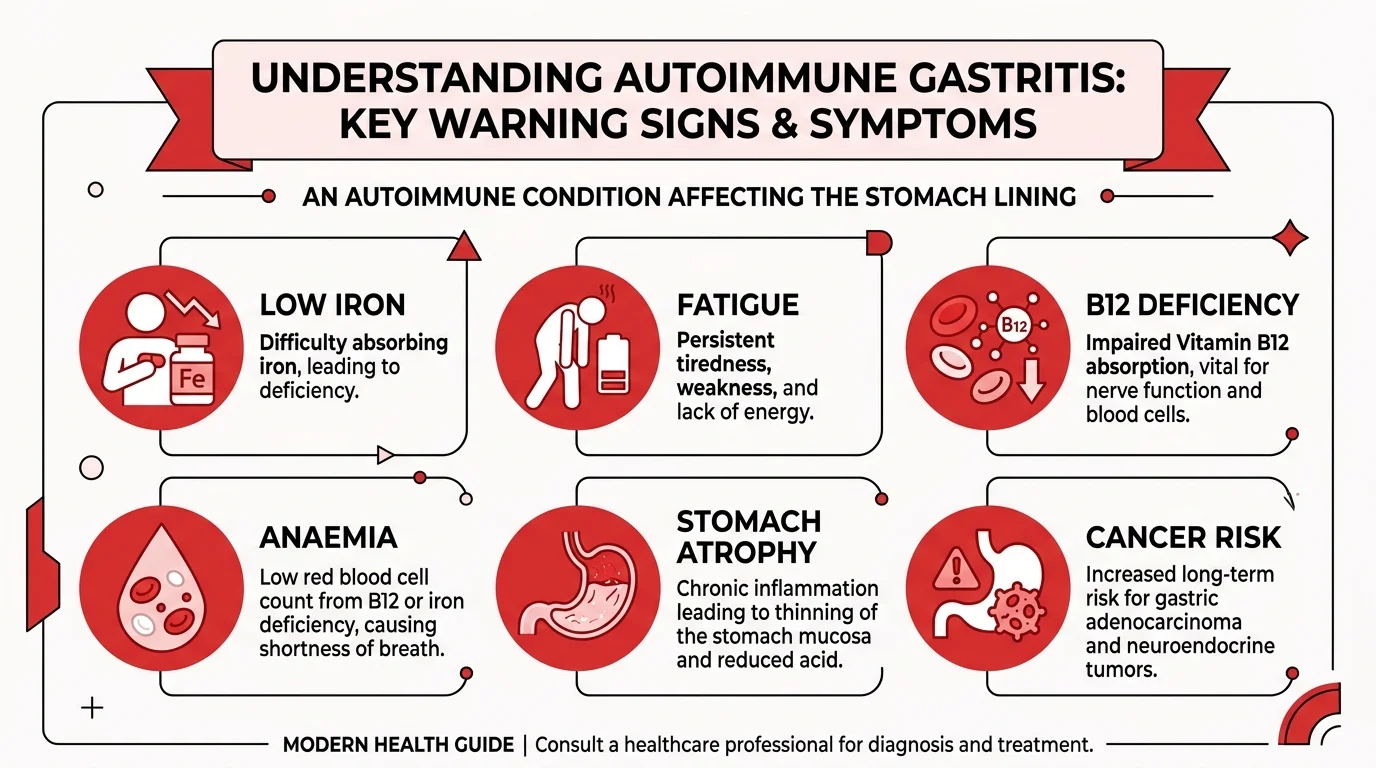
What Are the Symptoms of Autoimmune Gastritis? — UK Reader Guide
Because autoimmune gastritis — the condition behind Bryan Johnson Autoimmune Disease — often develops silently over many years, UK readers are increasingly asking how to recognise the early warning signs before serious complications set in.
An iron deficiency that does not resolve with standard treatment. This is often the first and most important clue. If your iron levels remain persistently low despite oral iron supplementation and no other obvious cause has been identified, autoimmune gastritis should be considered.
Unexplained fatigue and weakness, iron deficiency, and B12 deficiency are both downstream consequences of autoimmune gastritis, which cause significant fatigue. This is frequently attributed to other causes without the underlying autoimmune condition being identified. Recognising these signs early is exactly what could have shortened Bryan Johnson Autoimmune Disease diagnosis journey.
Neurological symptoms: Severe B12 deficiency can cause numbness and tingling in the hands and feet, cognitive difficulties, including brain fog and memory problems, and, in serious cases, spinal cord complications.
Symptoms of anaemia, such as pale skin, shortness of breath on exertion, heart palpitations, and persistent tiredness, can all indicate anaemia resulting from untreated autoimmune gastritis.
Family history of autoimmune conditions. Autoimmune gastritis is associated with other autoimmune conditions, including autoimmune thyroid disease (Hashimoto’s thyroiditis and Graves’ disease), type 1 diabetes, and vitiligo. Having one autoimmune condition increases the risk of developing others.
⚠️ Important: This article is for informational purposes only. If you are concerned about any of the symptoms described, please speak with your GP or a qualified healthcare professional. Do not self-diagnose or self-treat.
⚠️ Important: This article is for informational purposes only. If you are concerned about any of the symptoms described, please speak with your GP or a qualified healthcare professional. Do not self-diagnose or self-treat.
How Is Autoimmune Gastritis Diagnosed in the UK?
For UK readers who are concerned they may have autoimmune gastritis, here is how the diagnostic process typically works through the NHS:
Blood tests. Your GP will likely start with blood tests, checking your full blood count (for anaemia), serum ferritin and iron levels, and vitamin B12 levels. Anti-parietal cell antibodies and anti-intrinsic factor antibodies are specific markers for autoimmune gastritis and can also be tested and are highly indicative of the condition.
Referral to a gastroenterologist. If blood tests suggest autoimmune gastritis, your GP will typically refer you to a gastroenterologist for further investigation.
Endoscopy and biopsies. An upper endoscopy, where a thin, flexible camera is passed through the mouth into the stomach, is the gold standard for diagnosing autoimmune gastritis. Biopsies taken from the stomach lining during the procedure can confirm the diagnosis and assess the extent of damage.
Ongoing monitoring. Once diagnosed, regular endoscopic surveillance is recommended to monitor for precancerous changes, typically every one to three years. Regular monitoring remains central to how Bryan Johnson Autoimmune Disease is being managed going forward.
Bryan Johnson’s Response — “I’m Going to Try and Solve It”
True to his brand and his mission, Bryan Johnson Autoimmune Disease response has been characteristically defiant. “I’m going to try and solve it,” he wrote on X. “Will share all.”
In a subsequent interview with TMZ, Johnson described his reaction to the diagnosis as “wondrous,” a word that surprised many observers but reflects his broader philosophical approach to health challenges as opportunities for learning and optimisation.
Johnson has outlined a detailed management plan developed by his medical team, which includes targeted supplementation and ongoing monitoring. He has committed to sharing his progress publicly, which means his experience will likely generate significant ongoing data about how autoimmune gastritis progresses and responds to intensive management over time.
For the global medical community, Johnson’s willingness to share his health journey openly, even when it contradicts his longevity brand, is genuinely valuable. It raises awareness of a poorly understood and frequently missed condition, and may ultimately lead to better outcomes for the millions of people worldwide who are living with undiagnosed autoimmune gastritis.

Frequently Asked Questions — Bryan Johnson Autoimmune Disease 2026
What autoimmune disease does Bryan Johnson have?
Bryan Johnson Autoimmune Disease has been identified as autoimmune gastritis, a chronic condition in which the immune system mistakenly attacks the stomach lining. He revealed the diagnosis publicly in July 2026.
Is Bryan Johnson Autoimmune Disease curable?
No — Bryan Johnson Autoimmune Disease, like most autoimmune gastritis cases, is considered a lifelong condition rather than a curable one. No. Autoimmune gastritis is currently incurable. The damage to the stomach lining that has already occurred is permanent. However, the condition can be managed through supplementation and regular monitoring, and most people with autoimmune gastritis live relatively normal lives.
What is autoimmune gastritis?
Autoimmune gastritis, the condition central to the Bryan Johnson Autoimmune Disease story, occurs when the body’s immune system attacks the parietal cells of the stomach lining. These cells produce hydrochloric acid, which is essential for absorbing iron and vitamin B12. Over time, their destruction leads to iron deficiency, B12 deficiency, anaemia, and an elevated risk of stomach cancer.
How common is autoimmune gastritis in the UK?
Autoimmune gastritis is estimated to affect 2–5% of the population globally. However, experts believe it is significantly underdiagnosed because it often develops without obvious symptoms, and many patients are managed for iron deficiency or anaemia without the underlying cause ever being identified.
Can you get tested for autoimmune gastritis through the NHS?
Yes. Your GP can order blood tests checking for anti-parietal cell antibodies and anti-intrinsic factor antibodies, which are specific markers for autoimmune gastritis. A positive result typically leads to referral for endoscopy and biopsy to confirm the diagnosis.
Could I have autoimmune gastritis and not know it?
Yes — this is precisely what makes the condition so challenging. Autoimmune gastritis frequently develops without any obvious digestive symptoms. The most common early sign is persistently low iron that does not respond normally to supplementation. If this applies to you, speak with your GP.
Younger generations are increasingly aware of health costs. Read our guide on Gen Z money habits UK 2026 to see how they manage health and lifestyle spending.
Final Thoughts — What Bryan Johnson’s Diagnosis Means for All of Us
Bryan Johnson Autoimmune Disease diagnosis has sparked a much wider conversation about how silently autoimmune gastritis can progress before symptoms become obvious. Here is a man who has invested more in his health than virtually anyone on the planet, and an invisible, chronic condition still managed to hide from him for over a decade.
The lesson is not that health optimisation is futile. The lesson is that some diseases are extraordinarily difficult to detect, even with the most advanced medical surveillance available. And that for every Bryan Johnson with a team of doctors and millions of dollars, there are millions of ordinary people in the UK and USA whose autoimmune gastritis may never be diagnosed at all.
If Johnson’s story prompts more awareness, better diagnostic practices, and earlier identification of this overlooked condition, that may ultimately be the most significant contribution his diagnosis makes to public health.