

Sometimes choosing the right paint feels harder than actually painting. You spend hours looking at colors, only to realize they don’t match the vision in your head. If you’ve ever wondered what oil paint pigments best match your idea, you’re not alone. It’s a common struggle for artists who want accuracy without wasting time or money.
That’s exactly what this post will help you with. We’ll break down how oil paint pigments connect with the Munsell color system, which ones work best for reliable results, and how you can use them to achieve the shades you’re really after. By the end, you’ll have clear, practical guidance to make color mixing less stressful and more enjoyable.
Pigments
Oil painting begins with pigments, the raw color particles that give paint its identity. Traditional artists often relied on natural minerals like malachite, sienna, or umber, while modern paints add synthetic options such as phthalo blue and quinacridone rose. Each pigment carries unique traits: lightfastness, opacity, and tinting strength that affect how it looks on your canvas.
Choosing the right pigment isn’t just about color. For example, ultramarine blue (PB 29) offers a deep brilliance but can shift in mixtures, while cadmium red (PR 108) remains strong and opaque. Understanding pigment codes, like those in the Colour Index (PY 43 for yellow ochre, PBk 9 for ivory black), gives you control over consistency and reliability.
Paint Making Kits
Many artists experiment with paint-making kits, grinding pigments into linseed or walnut oil to create their own artist oils. This hands-on approach reveals just how much pigment quality and oil type matter. For instance, titanium white (PW 6) provides high opacity and brightness, while lead white (PW 1) creates softer, more subtle blends. Making your own paints also lets you explore rare earth colors such as Nicosia green earth or violet hematite.
Paints
Ready-made artist paints, whether from brands like Rublev Colours, Michael Harding, or Gamblin, offer consistency and convenience. Each brand has its take on pigment purity, with some emphasizing traditional mineral pigments while others rely on modern synthetics. For example, Rublev Colours is known for using natural earth pigments that match historical palettes.
When comparing paints, think about tinting strength and bias. Phthalo blue has incredible intensity but can easily overpower mixtures, while cerulean blue provides a softer, sky-like tone. Artists often build a palette of biased primaries (a cool and warm version of each primary color) to expand mixing possibilities without needing hundreds of tubes.
Mediums & Grounds
Oil paints don’t work alone; they need mediums and grounds to behave properly. Grounds like gesso or oil-primed canvas prepare the surface, giving tooth and stability. A good ground ensures that pigments retain brilliance rather than sinking into the canvas.
Mediums adjust paint handling and finish. Linseed oil boosts flow but can yellow over time, while safflower oil keeps whites brighter. Additives like damar varnish or stand oil extend gloss and drying control. Balancing your medium is key: too much oil creates a slick, slow-drying film, while too little can leave paint chalky.
Supports
Supports are the surfaces you paint on: canvas, wood panels, or even paper prepared with oil grounds. Canvas remains the most common, offering flexibility and texture. Linen is durable and preferred for professional work, while cotton is more affordable.
Wood panels, on the other hand, give a rigid surface ideal for detailed or miniature painting. Many classical works, icons, portraits, and altarpieces were painted on panels, demonstrating their longevity. Choosing supports depends on your style: broad expressive strokes often fit canvas, while meticulous layers benefit from panels.
Brushes & Tools
Your brushes shape the character of each stroke. Hog bristle brushes push heavy-bodied oil paint around with texture, while sable brushes glide pigment in smooth, delicate lines. Palette knives offer another level of expression, allowing for thick impasto or clean scraping techniques.
Other tools, such as mullers, jars, spatulas, and mahl sticks, support both paint making and painting practice. For example, a glass muller ensures even pigment dispersion when preparing custom paints. Simple tools, when used well, can transform the painting process into a more controlled and enjoyable craft.
Drawing
Before the first brushstroke, drawing sets the stage. Many artists block in their composition with graphite, charcoal, or thinned umber paint. A strong underdrawing saves time later, guiding proportion and preventing guesswork.
Drawing also helps when matching pigments to Munsell notations. By mapping values and hues in your sketch, you can align paint mixtures to the Munsell system more precisely. This ensures your final painting reflects the harmony you intended from the start.
Gilding
Although not as common today, gilding remains an inspiring technique for artists exploring classical traditions. Applying gold leaf to panels or borders creates a luminous backdrop for painted figures. Pigments like vermillion or ultramarine glow with extra brilliance when contrasted against reflective gold.
In historical painting, gilding symbolized divinity and prestige. Today, artists often blend gilding with modern pigments to explore new contrasts between metallic brilliance and earthy hues.
Sets
Oil paint sets are a convenient entry point for beginners and a time-saver for experienced painters. Student sets usually include titanium white, ivory black, ultramarine, burnt sienna, and yellow ochre. Professional sets might expand to cadmium reds, cobalt pigments, or viridian green.
Curated sets, like the Zorn palette (white, black, red, and yellow ochre), showcase how limited palettes can still achieve wide color ranges. Sets aligned with the Munsell color tree offer structured pathways to learn hue, value, and chroma relationships.
Munsell Color System Notations for Rublev Brand Oil Paints
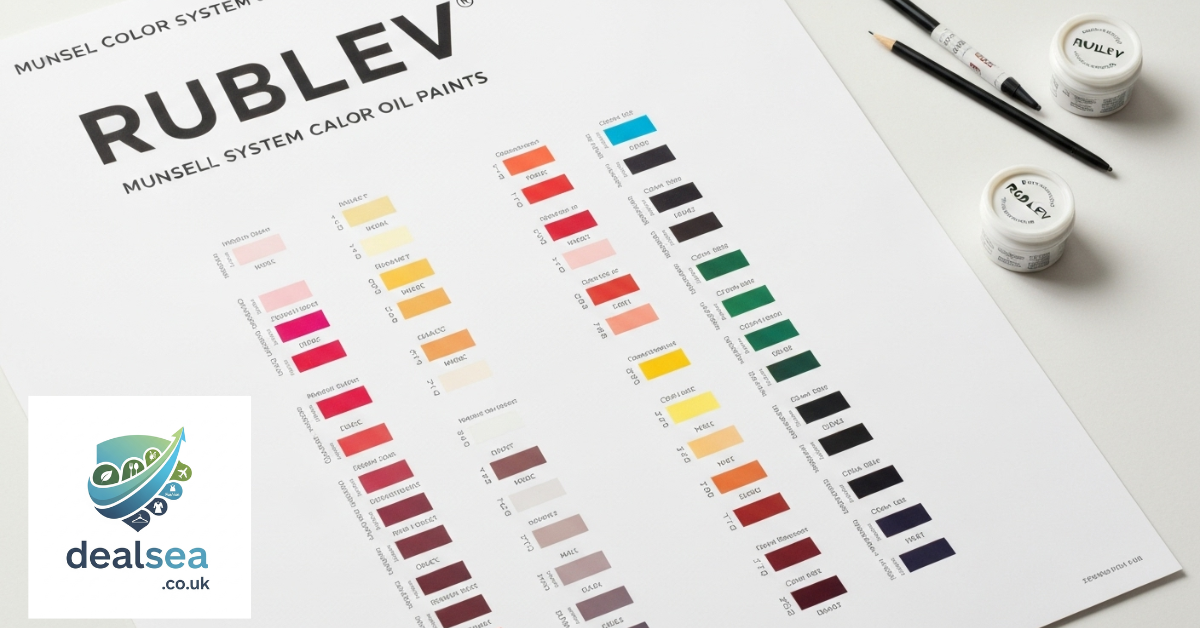
The Munsell color system organizes color into three attributes: hue, value (lightness), and chroma (saturation). Instead of relying on vague labels like “bright red” or “dark blue,” the system uses numeric scales and logical order. This precision helps artists eliminate guesswork when mixing.
Rublev Colours Artist Oils have been studied in relation to Munsell notation. By mapping pigments such as cadmium yellow, ultramarine blue, or hematite to Munsell codes, artists can select and mix paints more predictably. This creates a bridge between classical pigment traditions and modern scientific color models.
MORE ARTICLE:What oil paints pigments
How Munsell Color Notation Works
The Munsell system describes colors in steps. Hue is divided into families (red, yellow-red, yellow, green, blue, purple), while value runs from 0 (black) to 10 (white). Chroma measures intensity, from dull grey to vivid saturation. For example, ultramarine blue may fall in the 5PB hue family, with medium value and moderate chroma.
This structure makes it possible to compare pigments consistently. A spectrophotometer can measure samples on a Leneta card to confirm how titanium white shifts a color’s value, or how mixing phthalo green with cadmium yellow light produces a high-chroma yellow-green.
Rublev Colours Artist Oils
Rublev Colours emphasize historical and natural pigments, many of which align beautifully with the Munsell color tree. For instance, natural umbers (PBr 7) create low-chroma browns ideal for grounding paintings, while azurite or malachite bring subtle blue-green hues. Compared to synthetic phthalos, these pigments often deliver more nuanced, earth-like results.
Artists using Rublev Colours alongside the Munsell system can create palettes that balance precision with expressive character. The pigments not only meet modern analytical standards but also connect to centuries of artistic tradition.
About
Rublev Colours is dedicated to reviving traditional pigments and paint-making practices. By grinding minerals and earths into linseed oil, the company offers a unique palette that feels closer to historical paintings than many modern paints.
Resources
Educational charts, Munsell mapping guides, and pigment indexes are available for artists who want to explore the scientific side of color. These resources help painters understand hue bias, lightfastness, and mixing potential.
Support
Artists new to pigment science can access guides, customer support, and community discussions to refine their palettes.
Contact Us
For pigment questions, custom requests, or detailed technical support, Rublev Colours maintains direct contact with artists worldwide.
Our Brands
Different paint brands interpret pigments in their own ways. Michael Harding focuses on rich, pure modern pigments like cobalt teal or magenta, while Gamblin balances tradition with affordability. Each brand has varying oil binders, linseed, safflower, or walnut, that affect color aging and gloss.
Exploring multiple brands helps artists build a palette that meets their unique style. For some, earthy Rublev pigments align with classical realism; for others, high-chroma modern synthetics support abstract or contemporary expression.
A Pigment of Your Imagination
Painting is more than just applying color; it’s about interpreting light, form, and feeling. Artists often discover that the pigments they choose influence not only the canvas but also their process.
realist painting in a surrealist world
Realist painters strive for accuracy, yet the world itself is often surreal. By using tools like the Munsell system, they can ground their colors in logic while still capturing emotional impact. The balance between measurable values and artistic freedom creates timeless works.
Category Archives: Munsell
The Munsell system continues to inspire artists across disciplines. Its logical approach to hue, value, and chroma is just as useful for fine art as it is for design, education, and even soil studies.
PAINTING WHITE TO PLEASE THE HUMAN EYE
White pigments from lead white to titanium white remain essential. Each interacts with Munsell notations differently, shifting values and controlling brightness. Choosing the right white determines whether a painting glows softly or shines with stark brilliance.
FRANK COVINO, LONG-TIME FRIEND AND MENTOR, HAS PASSED
Frank Covino’s teaching often drew on Munsell notation to help students navigate the complexities of color mixing. His legacy reminds us that color systems bridge the gap between science and art.
RAINBOW HUES
The rainbow is nature’s spectrum, but on canvas, pigments must approximate it. Munsell notation helps place these hues logically, guiding mixtures of cadmium orange, ultramarine violet, or viridian green into structured harmony.
Color mixing inspired by the Munsell system
Artists often struggle with color mixing because pigments don’t always behave as expected. The Munsell system offers a roadmap: by mapping tube colors to hue, value, and chroma, you can mix with greater confidence.
Reader Interactions
Leave a Reply Cancel reply
Sharing experiences with pigments and Munsell notation helps artists refine their practice. Discussions around ultramarine vs phthalo blue, or cadmium yellow vs hansa yellow, deepen community knowledge.
Primary Sidebar
Snapshot of the Author
The author, a lifelong painter, has explored both natural earth pigments and synthetic modern hues, blending them with Munsell notation for precision.
Subscribe via E-mail
Stay connected for more insights on pigments, palettes, and painting techniques.
Featured
Highlighted resources include Munsell charts, pigment indexes, and practical mixing guides.
Search OPA Blog
Find more discussions about artist palettes, color mixing, and painting practice.
Guest Blogger Schedule
Artists worldwide share their perspective on oil paints and the Munsell system.
OPA Blog Reference
Curated references help link pigment chemistry to visual results.
Footer
Color is both science and art—this blog connects the two, one pigment at a time.
Fun with the Munsell Wheel!
Playing with the Munsell color wheel reveals relationships between hues that might not be obvious otherwise. By experimenting with hue families, you’ll discover fresh pathways in your palette.
Comments (0)
Readers are encouraged to share thoughts on pigments and Munsell notations.
Welcome to my blog
This space is dedicated to helping artists navigate the colorful world of oil paints.
Subscribe below to receive updates by email.
Stay up to date with new guides on pigments, Munsell notation, and painting practice.
Subscribe to my blog
Brand Ambassador for Michael Harding Handmade Artists’ Oil Colours
Exploring vibrant modern pigments like cobalt turquoise, scarlet lake, and bright green lake.
The Science of Oil Paints with Kyle Kolbe
Color isn’t just artistic, it’s scientific. By combining pigment chemistry with the Munsell color system, artists can make informed, repeatable choices.
Mix Oil Colors
Buy Your First Palette of Oil Colors
Starting with a core palette of ultramarine blue, cadmium red, yellow ochre, ivory black, and titanium white gives you a foundation for learning.
More than a Tube
Each tube contains history, chemistry, and potential waiting to be unlocked.
False Economies
Cheap student paints often lack pigment strength, making mixing more difficult.
The Zorn Mini Palette
White, black, yellow ochre, and red create a surprisingly broad spectrum.
The Full Biased Mixing Palette
Adding warm and cool primaries expands mixing power.
Biased Primaries
Required:
Ultramarine, phthalo blue, cadmium red, alizarin crimson, cadmium yellow, hansa yellow.
Optional:
Cobalt violet, viridian, cerulean blue.
Earth Colors
Burnt sienna, raw umber, and venetian red provide muted tones.
Neutrals
Ivory black, Mars black, titanium white.
Convenience Colors
Phthalo green, manganese violet, napthol red for quick, high-chroma solutions.
Understand Paint Properties
Paint is Paint, Right?
Not all paints are equal; pigment load, oil binder, and fillers matter.
Why Are Artist Colors Better?
Higher pigment concentration means stronger tinting and longer-lasting paintings.
So I can just buy any Artists Color and get great results?
Not knowing hue bias and pigment codes ensures predictable mixing.
Mix Colors Smarter
Understand Munsell Color Notation
Munsell provides a logical system for mixing colors predictably, aligning pigments with hue, value, and chroma.
Do you want to learn to mix any color predictably from a limited palette?
The Munsell system and biased primaries make it possible.
Know Your Color’s Bias
Every pigment leans toward warm or cool. Knowing this prevents muddy mixtures.
Manipulate Paint Properties
Control the Cure and Reduce Shine
Medium choice and drying environment affect surface finish.
Expect Color Sinking
Some pigments sink in oil films, adjust with mediums, or layer.
Set Up a Biased Palette
Organize pigments to maximize mixing potential.
Know Your Color Profiles
Track pigment codes, Munsell notations, and visual results for consistent work.
Biased Primary Profiles
Green-Yellow
Hansa yellow vs cadmium yellow light.
Yellow-Red
Cadmium red vs napthol red.
Blue-Green
Phthalo blue vs viridian.
Purple-Blue
Ultramarine vs cobalt violet.
Red-Purple
Alizarin crimson vs quinacridone magenta.
Red-Yellow
Cadmium orange vs pyrrole red.
Earth Profiles
Earth Yellow
Yellow ochre, raw sienna.
Green-Brown
Terra verte, green umber.
Red-Brown
Burnt sienna, Venetian red.
Neutral Profiles
Cool Black
Ivory black with blue undertones.
Opaque White
Titanium white for strong coverage.
Tinting White
Mixing white for subtle lighting.
Greys
Neutral mixes using black and white.
Opaque Black
Mars is black, dense, and strong.
Shading Black
Bone black for softer shadows.
Convenience Profiles
Transparent Blue
Phthalo blue for glazing.
Transparent Green
Phthalo green for rich layers.
Flesh’s Secret
Napthol red with yellow ochre and white.
A Bluer-Black
Mixing ultramarine with black for depth.
Excited for More?
Contact and subscribe
Stay connected to explore new pigment guides and Munsell-based mixing techniques.
FAQS
What oil paints do professional artists use?
Professional artists often use high-quality brands like Winsor & Newton, Rembrandt, and Old Holland for their rich pigments and durability.
What are the different grades of oil paint?
Oil paints come in two main grades: student-grade (affordable, with less pigment) and artist/professional-grade (higher pigment, better quality).
How long does oil paint take to dry?
Oil paint can take anywhere from 2 days to several weeks to dry, depending on its thickness, color, and environmental conditions.
Where are Rembrandt oil paints made?
Rembrandt oil paints are made in the Netherlands by Royal Talens.